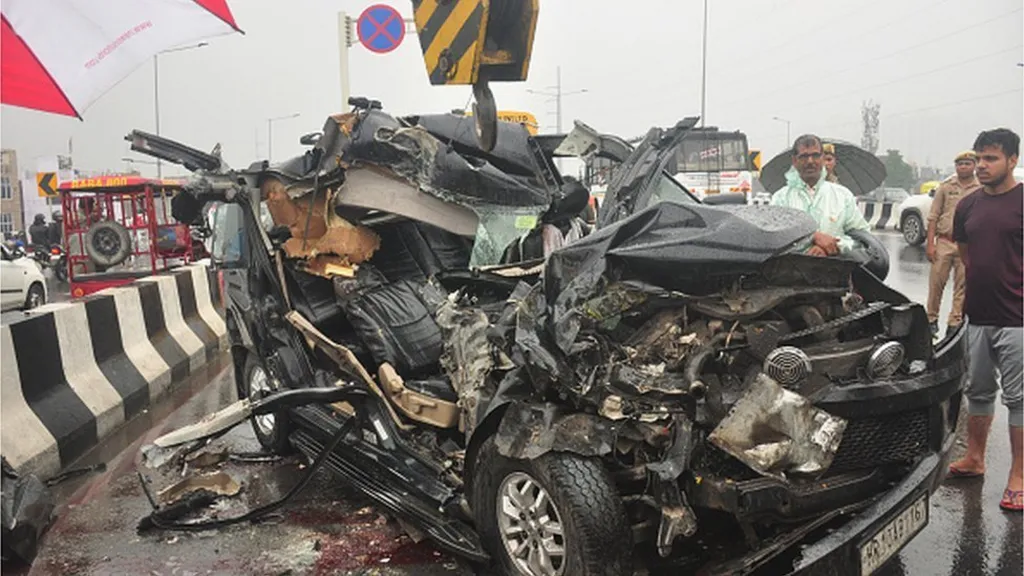
Speeding does not discriminate by continent, income level, or road quality. The World Health Organization estimates 1.19 million people die on the world's roads every year — roughly one death every 26 seconds. Speed is a contributing factor in approximately 30% of fatal crashes globally, making it consistently the most lethal behavioural risk factor across every road environment studied, from expressways in Germany to rural highways in the United States to city corridors in India.[5][8]
In the United States, a country with some of the world's most resourced enforcement infrastructure — radar cameras, highway patrol, substantial fines — speeding has been involved in approximately one-third of all traffic fatalities for more than 20 consecutive years. In 2024, that figure was still 29%: 11,288 lives. The percentage has not moved in two decades, despite every enforcement tool available.[3]
In India, the numbers are starker. The Road Accidents in India 2023 report — released by MoRTH following a Supreme Court directive — recorded 172,890 road deaths and 480,583 accidents, a new all-time high. The top cited cause, accounting for 68% of all fatalities, is the same cause that led the list every year prior: overspeeding. Sixty-eight percent of 172,890 is approximately 117,000 deaths in a single year.[1]
"Speed kills in every country that has studied it. What varies is not the physics — it is whether the enforcement system travels with the vehicle or waits by the roadside."
The question is not whether overspeeding is the problem. The data from New Delhi to Washington DC is unambiguous. The question is what kind of intervention can actually move that number — and why every approach tried so far has not.
The Physics You Cannot Argue With
Crash energy scales with speed squared
Speed does not kill linearly. The kinetic energy a vehicle carries is expressed as ½ × mass × velocity². The velocity is squared. Going from 60 km/h to 80 km/h — an increase of 33% — does not increase the energy released in a crash by 33%. It increases it by 78%. Going from 80 to 120 km/h — which happens routinely on Indian expressways — more than doubles the crash energy. Every joule of that energy must be absorbed by the vehicle structure, road infrastructure, or human body.
Stopping distance compounds the problem. A vehicle travelling at 60 km/h on a dry road with well-maintained brakes requires approximately 36 metres to stop from the moment the driver perceives a hazard. At 80 km/h, that figure rises to 64 metres — nearly double. At 100 km/h, it exceeds 90 metres. The reaction time (typically 1.5–2 seconds for an alert driver) adds 25–55 metres of travel before the brakes even engage.[8]
The Power Model: every km/h matters
The relationship between speed and crash severity has been quantified in what road safety researchers call the Power Model, originally developed by Göran Nilsson and subsequently validated across dozens of countries and road environments. The finding: a 1% increase in mean travel speed produces approximately a 4% increase in fatal crash risk, and a 3% increase in serious-injury risk.[8] Conversely, a 5% reduction in mean speed — on a road where the average is 80 km/h, that is 4 km/h — is projected to reduce fatal crashes by roughly 19%.
The same relationship appears in pedestrian survival data. According to WHO road safety research, a pedestrian struck by a vehicle travelling at 80 km/h faces approximately an 85% probability of death. At 50 km/h, that falls to around 45%. At 30 km/h — the posted limit in most residential zones and school precincts — it falls below 10%.[8] The road signs that specify 25 or 30 km/h near schools are not arbitrary. They are calibrated to keep survivability high when human error occurs.
The Numbers Across Three Markets
India, the United States, and the EU — the same problem, different scales
A direct percentage comparison across countries requires care. India's 68% and the United States' 29% are not identical metrics: India's MoRTH/NCRB figures assign a single "main cause" to each crash based on officer judgment, while NHTSA's 29% flags crashes where speed was a contributing factor. India's two official sources even disagree with each other — MoRTH reports 68% for 2023; the National Crime Records Bureau reports 61.4% for the same year. A WHO common-methodology comparison, which normalises for population, places India at 15.4 deaths per 100,000 and the United States at 14.2 per 100,000 — a far smaller gap than the percentages suggest.[3][4][5]
What the numbers share, regardless of methodology, is persistence. India's overspeeding toll hit a new all-time high in 2023. The US speeding share has hovered near 29–33% for more than 20 years with no meaningful downward movement. In the European Union — where fines are steep, cameras are dense, and road infrastructure is world-class — speeding still accounts for an estimated 30% of all fatal crashes, which is precisely why the EU became the first major jurisdiction to mandate technology-based speed assistance for all new vehicles in 2024.[6][7]
| Metric | India (MoRTH 2023) | United States (NHTSA 2024) | European Union |
|---|---|---|---|
| Total road fatalities | 172,890 | ~39,345 | ~20,400 (2023) |
| Speeding share of fatalities | 68% (MoRTH) | 29% (20-yr constant) | ~30% (EC estimate) |
| Absolute speeding deaths | ~117,600 | 11,288 | ~6,100 |
| WHO rate (per 100,000 pop.) | 15.4 | 14.2 | ~5.0 (EU avg.) |
| Tech-based speed mandate | CMVR Rule 118 (static 80 km/h cap) | None federal | ISA mandatory — all new vehicles from July 2024 |
Why Existing Measures Are Not Enough
The blanket 80 km/h speed limiter (CMVR Rule 118)
India mandated Speed Limiting Devices (SLDs) for all commercial vehicles in October 2015 under CMVR Rule 118, capping them at 80 km/h. This is a meaningful intervention — a truck that cannot exceed 80 km/h cannot cause a 120 km/h crash. But it has a critical blind spot: it is context-blind. The same device applies the same ceiling whether the vehicle is on an eight-lane expressway outside a city at 2 AM or inching through a school zone at 8 AM.
Most urban roads carry posted limits of 50 km/h. Residential areas and school zones specify 25–30 km/h. A vehicle at 79 km/h — technically within the CMVR cap — is travelling at more than three times the posted limit in those zones. The SLD mandate addresses highway catastrophes. It does not address the residential-zone, market-road, and school-precinct collisions that represent a large share of India's pedestrian and cyclist fatalities.
Driver training alone does not hold
Training-based interventions are effective — but ephemeral. Research covering 2,604 drivers and 341 million kilometres of fleet operations found that eco-driving and safe-driving behaviour gains from training decay significantly within 90 days without continuous reinforcement.[9] Human attention is finite, incentives shift, and road environments change. A driver who completed a speed-awareness course six months ago faces the same cognitive load as one who never did, when they are navigating a 14-hour night delivery across mixed road conditions. Training is necessary. It is not sufficient.
The EU tried — and even fines and cameras weren't enough
The European Union is the most instructive case study precisely because it cannot be dismissed as a developing-world infrastructure problem. The EU has modern roads, dense camera coverage, substantial fines, and well-resourced traffic police. Despite all of this, speeding consistently contributed to an estimated 30% of fatal crashes across member states — a figure that decades of enforcement spending failed to shift.[7]
The EU's response, codified in General Safety Regulation 2019/2144, was to mandate technology directly on the vehicle. From July 6, 2022, ISA became required for all new vehicle types; from July 7, 2024, it is required for every new car, truck, and van sold in the EU — regardless of model year. Every vehicle rolling off a European production line now ships with GPS-aware speed assistance that displays the posted limit, warns the driver when they exceed it, and applies gentle resistance to the throttle.[6]
That mandate is a landmark validation of the technology-first approach. But it has three important limitations that define the market opportunity for systems like CarPod everywhere else:
EU ISA is advisory — drivers can override it
The regulation explicitly requires that ISA "work with the driver, not restrict their ability to act at any moment." A driver who deliberately presses through the throttle resistance can exceed the limit. EU ISA is a warning system with friction — not a hard enforcement ceiling. Early field data suggest hard-limit systems prevent significantly more violations than advisory ones.
EU ISA only covers new vehicles
The mandate applies to new production. The hundreds of millions of vehicles already on European roads have no ISA — and with the average car lasting 12–13 years in Europe, much of the current fleet will not have factory-fitted ISA until the mid-2030s. The existing vehicle population, where most crashes happen today, is entirely untouched.
No equivalent mandate exists in the US or India
ISA is not federally mandated in the United States, not mandated in India beyond the static 80 km/h SLD rule, and not required across most of Asia, the Americas, or Africa. The regulatory solution is still regional; the road safety problem is global.
Fines only work when there is someone watching
The US is the case that makes the point most clearly. The United States has decades of investment in speed enforcement: highway patrol, automated radar, weigh stations, substantial fines, and in many states a dense network of fixed speed cameras. Despite all of it, speeding has been involved in approximately one-third of all US traffic fatalities for more than 20 consecutive years. In 2024, the share was still 29% — statistically indistinguishable from where it stood in 2000. The number of lives lost — 11,288 in 2024 — is not declining relative to total traffic.[3]
The reason is structural, and it applies equally in Mumbai and Minneapolis. No external enforcement system achieves saturation. The US Interstate Highway System alone spans 77,000 km. India's road network is 3.4 million km — the second-largest in the world. A commercial driver on the same corridor 200 times knows exactly where every camera and patrol point sits. Between those fixed points, the road is effectively unmonitored — and the driver knows it. A fine in that context is not a deterrent; it is a theoretical cost with no bearing on behaviour in the moment.
Camera-based enforcement introduces its own failure mode: drivers slow for the camera and accelerate immediately after. Research on fixed speed cameras consistently shows strong point compliance and weak corridor compliance — speeds drop within 200–300 metres of a camera and recover within 500 metres beyond it. Night hours, rural corridors, and minor roads remain largely unmonitored everywhere.
"You cannot police every road, in every country, around the clock. The EU proved that fines and cameras alone cannot move the speeding death share — even with world-class infrastructure. The only enforcement that works everywhere, always, is the kind that travels with the vehicle."
India's Motor Vehicles (Amendment) Act 2019 raised overspeed fines to up to ₹4,000 per citation for commercial vehicle operators — a meaningful increase, but one that still depends on being caught. On a night run on NH-44 between Nagpur and Hyderabad, or hauling freight on a rural state highway through Rajasthan, a driver knows with near certainty that no officer is present. The fine is a theoretical cost; the speeding is a present reality.
This is the shared failure mode of fines, cameras, and signage across all three markets: they are external controls that require surveillance infrastructure no government can deploy at scale. The intervention that works on every road, in every country, at every hour, without a single officer or camera, is one that travels with the vehicle.
"A speed limit sign informs the driver. A fine penalises them after the fact. Only a device that enforces the limit in real time — the moment it changes — removes the opportunity for the violation to occur."
How CarPod's Adaptive Speed Limit Works
The core problem with static speed governors
A traditional Speed Limiting Device is programmed with a single ceiling — typically 80 km/h per CMVR Rule 118 — and applies that ceiling everywhere, all the time. It knows nothing about the road it is on. It cannot distinguish a highway from a school precinct. It cannot react when a vehicle crosses into a work zone where the posted limit drops to 40 km/h. It cannot distinguish night from school hours.
CarPod's Adaptive Speed Limit (ASL) is built on a fundamentally different architecture: real-time, location-aware speed limit enforcement that reflects the authority-defined limit at every point on every road.
Location + authority data = context-aware enforcement
ASL fuses two inputs. First, the CarPod's multi-constellation GNSS receiver (GPS / GLONASS / NavIC) establishes the vehicle's position to within ±2.5 metres, refreshing continuously as the vehicle moves. Second, a speed limit layer — sourced from map providers whose data reflects government-gazetted limits set by NHAI, state Public Works Departments, and municipal authorities — supplies the posted limit for every road segment the vehicle is on or approaching.
The result is a dynamic, real-time enforcement ceiling that moves with the vehicle through every zone it crosses. As the vehicle transitions from a national highway to a state highway, from a state highway to an urban arterial, from an arterial to a school precinct, the enforced limit updates — automatically, without driver input. The CMVR Rule 118 hard ceiling of 80 km/h is encoded as an inviolable upper bound: wherever the map limit exceeds the regulatory cap, the lower value applies. Where speed limit data is unavailable, the regulatory cap applies as the safe default.
Zone-by-zone in practice
A typical inter-city delivery route crosses six or seven distinct speed-zone types. ASL tracks them all:
A 5 km/h hysteresis band prevents rapid mode switching at zone boundaries — so the vehicle does not oscillate between enforcement thresholds when it is near a transition point. Upcoming zone changes are surfaced to the driver 500 metres in advance via the in-cab display and an audio cue, so the speed reduction can be gradual and comfortable rather than abrupt.
Three enforcement modes — fleet manager's choice
Fleet managers configure enforcement behaviour via the FleetOS cloud dashboard. No firmware flashing, no workshop visit — it is a policy change applied over-the-air:
| Mode | What happens at the zone limit | Driver experience | Best for |
|---|---|---|---|
| Advisory | In-cab audio alert + HMI visual warning; driver retains full throttle control | Informed; free to comply or not | Driver culture-building phase; data collection baseline |
| Soft Limit | Throttle response ramps down as speed approaches the zone limit; driver can push through with deliberate pedal input | Friction; speeding requires active effort | General fleet policy; balance of safety and driver autonomy |
| Hard Limit | Speed ceiling is mechanically enforced; crossing the limit requires a deliberate secondary action that is logged | Cannot exceed limit without a logged event | CMVR Rule 118 compliance; school buses; high-risk urban corridors; insurance programmes |
Every exceedance, zone transition, and advisory alert is timestamped, geocoded, and surfaced in FleetOS — giving fleet managers per-driver compliance scores, high-risk corridor heatmaps, and an audit trail that strengthens the case for insurance discounts and regulatory compliance documentation.
What the Evidence Shows About Speed Enforcement
The EU mandate: what it proves — and where it stops short
The EU ISA mandate, now fully in force for all new vehicles as of July 2024, is the highest-quality evidence available that technology-based speed management works where enforcement alone does not. The European Commission projects the mandate could prevent 140,000 serious injuries by 2038 and contributes to the EU's Vision Zero goal of eliminating road fatalities by 2050.[6] The European Transport Safety Council estimates mass ISA adoption can reduce serious accidents by up to 30%.[7]
Critically, EU ISA as mandated is an advisory system — it alerts and applies throttle resistance, but drivers can override it. CarPod's ASL in Hard Limit mode goes further: it makes exceeding the posted limit a deliberate, logged secondary action rather than a matter of pressing harder. Fleet operators who want more than the EU's minimum advisory standard — and commercial fleet risk managers typically do — can configure the enforcement level that their risk profile and insurer require. The EU mandate sets the floor. CarPod lets you raise it.
What a 30% reduction means in numbers
Globally, the ETSC's 30% projection applied to the speeding-attributed share of 1.19 million annual road deaths represents roughly 100,000 lives per year — the scale of what technology-based speed management could deliver at full deployment. Even at partial penetration, the numbers are striking: a conservative 20% reduction in overspeeding-attributed fatalities in India alone — not 30%, not fleet-wide, just 20% on the installed base — would prevent approximately 23,400 deaths per year. In the United States, 20% of NHTSA's 11,288 speeding deaths is 2,258 lives annually. These are not marginal gains.
Location-Aware Limit — Not a Single Cap
Unlike a fixed 80 km/h SLD, ASL knows whether the vehicle is on a national highway, a state road, or a school precinct — and enforces the authority-defined limit for that specific location. A blanket cap set at 80 km/h allows a vehicle to be 3× the posted limit in a school zone. ASL does not.
Covers highway → urban → school zone transitionsDynamic Update — Continuous, Not One-Time
Speed limits change along every route — often every few hundred metres in urban areas. ASL refreshes the enforced limit continuously as the vehicle moves, with upcoming zone changes pre-announced to the driver. The system operates on cached map data, so it functions reliably in low-connectivity corridors.
Refreshes every 100 m of travelFleet Intelligence — Every Violation Is Logged
Advisory and exceedance events are timestamped, geocoded, and reported to FleetOS. Managers see per-driver compliance scores, high-risk corridors, and pattern data to inform training, routing, and scheduling decisions. The data is the accountability layer that makes the technology sticky.
Per-driver compliance scores in FleetOSRegulatory Proof — CMVR Rule 118 Plus
CarPod's Hard Limit mode satisfies CMVR Rule 118's 80 km/h commercial vehicle cap by design — and then goes further, enforcing lower posted limits where they apply. The compliance audit trail generated by FleetOS satisfies the documentation requirements of MoRTH's AIS-140 telematics mandate.
iCAT-certified | AIS-140 compliantThe Financial Argument for Fleet Operators
Direct cost: fines and litigation
The Motor Vehicles (Amendment) Act 2019 revised overspeed penalties substantially. Section 183 of the Motor Vehicles Act specifies fines of ₹2,000–₹4,000 per citation for heavy and medium commercial vehicle operators; Section 206(4) authorises licence impounding for repeat violations.[10] A 100-vehicle fleet averaging two citations per vehicle per month accumulates ₹4.8–9.6 lakh per month in direct fines — before licence reinstatement fees, schedule disruption, or legal costs. ASL in Hard Limit mode eliminates driver-behaviour-driven violations mechanically. Fine avoidance alone, for that 100-vehicle fleet, is worth approximately ₹72 lakh per year.
Indirect cost: accident downtime
A single significant accident typically takes a commercial vehicle off the road for 15–30 days — police investigation, insurance processing, vehicle repair, and driver replacement all compound. At ₹8,000–₹12,000 per day in lost revenue, preventing just one accident per 100 vehicles per year saves ₹12–18 lakh in downtime. Fatal accidents involving third parties carry civil liability exposure that dwarfs both figures.
Insurance premium reduction
Multiple Indian general insurers now offer 5–15% commercial vehicle premium reductions for fleets with AIS-140 telematics certification and documented safety monitoring. A fleet with FleetOS-generated ASL compliance reports — showing zone-level speed adherence per driver — has a quantified, auditable safety case that a conversation with an underwriter cannot match.
| Financial category | Basis | Annual value — 100 vehicles |
|---|---|---|
| Overspeed fine avoidance | 2 citations/month/vehicle × ₹4,000 avg. | ₹72 lakh |
| Accident downtime avoidance | 1 accident avoided/100 vehicles × 20 days × ₹10,000/day | ₹20 lakh |
| Insurance premium reduction | 10% on typical ₹1.2 lakh commercial vehicle premium × 100 | ₹12 lakh |
| Total safety-side saving | ~₹1.04 crore / yr |
Illustrative estimates based on MV Act 2019 fine schedules, industry downtime benchmarks, and indicative insurer discounts. Validate against your fleet's specific route profile and insurer terms before commitment.
Regulatory Alignment
India's regulatory direction is unambiguous: mandatory electronics, mandatory data reporting, and mandatory active safety systems — phased in between 2024 and 2028. CarPod is designed to be ahead of every one of those requirements.
Speed Limiting Device
80 km/h hard cap for all commercial vehicles, in force since 2015
✓ Compliant + ExceededMandatory Telematics
GNSS tracking, 4G uplink, panic button — required for contract carriage and transport
✓ CertifiedOverspeed Penalties
₹2,000–₹4,000/citation; licence impounding for repeat HCV/MCV violations
✓ Compliance DocumentedAEBS Mandate
Active Emergency Braking from 25 km/h — deployable via OTA software upgrade on existing CarPod hardware
On RoadmapFull ADAS Suite
Drowsiness detection, blind-spot detection, lane departure warning — Car.OS modules + camera add-on
On RoadmapIntelligent Speed Assistance
ASL is functionally equivalent to the EU ISA mandate — supports export fleet and global OEM positioning
✓ EquivalentBecause Car.OS is OTA-updatable, the AIS-162 AEBS mandate arriving in 2026–2028 can be delivered as a software module to existing CarPod hardware — no vehicle recall, no reinstallation. The device you install today is the device that remains compliant through the next mandate wave.
Why Aftermarket Is the Only Answer at Scale — in Any Market
The EU mandate covers only new vehicles — and even Europe's relatively fast fleet turnover means the majority of vehicles currently on European roads will not have factory-fitted ISA until well into the 2030s. In the United States, there is no federal ISA mandate at all; the average US car stays on the road for 12+ years, meaning even if a mandate passed today, most of the current fleet would not be covered for a decade or more. In India, more than 60% of the commercial fleet was registered before BS-VI (pre-April 2020), and new production represents less than 8–10% of the total fleet per year.
The math is the same in every market: if the goal is to reduce speeding deaths this decade — not in 2035, not after the fleet turns over — the only viable path is an aftermarket solution that works on vehicles already in service, requires no OEM cooperation, and installs in under two hours.
In India: iCAT-certified, compatible with 150+ vehicle models across all major Indian OEMs, operating on 20 million validated kilometres across 125+ cities. Deployable on any commercial vehicle regardless of age or brand, with no CAN bus access required.
In the US and globally: The same GPS-plus-authority-data architecture that makes ASL work on an Indian national highway works on any road where authoritative speed limit data exists — which today means virtually every road in North America and Europe. Fleet operators in any market who want more than the EU's advisory-only minimum, or who operate in markets where no mandate exists, can deploy CarPod's configurable enforcement today.
Every kilometre of operational data makes the speed-limit layer more accurate. Every zone transition recorded improves hysteresis tuning and driver advisory timing. The platform compounds in accuracy and value for every user on every route — and that compounding effect is global.
References
- [1]Ministry of Road Transport & Highways (MoRTH). (2025, released August). Road Accidents in India 2023. New Delhi: Transport Research Wing, MoRTH. Report released following Supreme Court directive. morth.nic.in
- [2]Ministry of Road Transport & Highways (MoRTH). (2023). Road Accidents in India 2022. New Delhi: Transport Research Wing, MoRTH. (2022 data: 461,312 accidents, 168,491 deaths; 72.3% of accidents and 71.2% of deaths attributed to overspeeding.) morth.nic.in
- [3]National Highway Traffic Safety Administration (NHTSA). (2024). Traffic Safety Facts 2023 Data: Speeding. DOT HS 813 721. Washington, DC: NHTSA National Center for Statistics and Analysis. (11,775 speeding-related fatalities; 29% of 40,901 total traffic deaths.) crashstats.nhtsa.dot.gov
- [4]National Crime Records Bureau (NCRB). (2024). Accidental Deaths & Suicides in India 2023. New Delhi: Ministry of Home Affairs. (Reports 464,029 road accidents, 173,826 deaths, 61.4% attributed to overspeeding — 7 points lower than MoRTH's 68%, illustrating inter-agency divergence in attribution methodology.) ncrb.gov.in
- [5]World Health Organization (WHO). (2023). Global Status Report on Road Safety 2023: Country and Territory Profiles. Geneva: WHO. (India: 15.4 per 100,000 population; USA: 14.2 per 100,000. India responsible for 13% of worldwide road traffic deaths.) who.int
- [6]European Parliament and Council of the European Union. (2019). Regulation (EU) 2019/2144 of the European Parliament and of the Council — General Safety Regulation. Official Journal of the European Union L 325, 18 December 2019. (Mandated Intelligent Speed Assistance for all new vehicles sold in the EU from July 2022, citing that 10–15% of all crashes and 30% of fatal crashes are directly attributable to speeding.) eur-lex.europa.eu
- [7]European Transport Safety Council (ETSC). (2021). Intelligent Speed Assistance: Potential Impact on Road Safety. Brussels: ETSC. (Projection: mass-adoption ISA can reduce serious accidents by up to 30%.) etsc.eu
- [8]World Health Organization (WHO). (2008). Speed Management: A Road Safety Manual for Decision-Makers and Practitioners. Geneva: WHO Global Road Safety Partnership. (Power Model: every 1% increase in mean speed → ~4% increase in fatal crash risk; pedestrian survival rates at varying impact speeds.) who.int
- [9]Traffic Injury Research Foundation (TIRF). (2023). Quantifying the Benefits of Eco-Driving for Transportation Employers. Ottawa: TIRF / Natural Resources Canada. (Study covering 2,604 drivers and 341 million kilometres; driver-to-driver fuel variance up to 35%; gains from training decay without continuous reinforcement.)
- [10]Motor Vehicles Act, 1988, Section 183 and Section 206(4), as amended by the Motor Vehicles (Amendment) Act 2019 (No. 32 of 2019). Parliament of India. (Specifies ₹2,000–₹4,000 per overspeed citation for HCV/MCV operators; licence impounding for repeat violations.) legislative.gov.in
- [11]Singh, P., Bhardwaj, P., & Kaur, P. (2018). Road traffic accidents: A cross-sectional study from Chandigarh linking police and hospital records. International Journal of Community Medicine and Public Health, 5(2), 579–584. (Record-linkage study: "Only 15% cases from the police records were matched with the hospital records," indicating significant under-counting in official Indian crash statistics.)
- [12]Hsiao, M., et al. (2013). Road traffic injury mortality and its mechanisms in India: Nationally representative mortality survey of 1.1 million homes. BMJ Open, 3(8), e002621. (Million Death Study: estimated road-injury deaths notably higher than police-reported figures.) doi.org/10.1136/bmjopen-2013-002621
- [13]GBD 2016 Road Injuries Collaborators. (2019). Global, regional, and national burden of road injuries, 1990–2016. Lancet Public Health, 4(5), e222–e239. (Estimated 218,876 road-injury deaths in India in 2017, 95% UI 201,734–231,141 — substantially above the police-reported figure for that period.) doi.org/10.1016/S2468-2667(19)30021-4
Put dynamic speed control to work for your fleet.
CarPod installs in under two hours on 150+ vehicle models — no CAN bus access, no OEM cooperation. Talk to us about a pilot deployment on your highest-risk corridor.
Talk to Us